My child will not share toys: Teaching turns without forcing generosity
Your child gathers every toy into their lap just before a friend arrives. It can look unwelcoming, yet “share” asks for several difficult things at once: stop an enjoyable activity, wait, and trust that something precious will return. The goal is not instant surrender whenever another child asks. It is learning a workable way for both children’s needs to matter.
Match expectations to developing skills
Consistent sharing can be unrealistic between one and three years. Preschoolers gradually understand turns and fairness, while school-age children can still struggle when excited or upset. Raising Children Network describes this as a developing skill, not a switch that flips on a birthday. These age ranges provide context; they are not diagnostic cut-offs. Raising Children Network: Sharing
Look at the separate tasks inside sharing
A child needs to notice what they want, communicate it, recognise another person’s wish, wait and return to play. Difficulty with one part can make the whole situation hard. “You want to finish driving the truck” describes a need more precisely than “You never share.” One difficult park encounter does not predict the kind of friend a child will become.
Distinguish personal belongings from shared equipment
Before a visitor arrives, let your child choose a few precious objects to put away. Explain which remaining materials are available for playing together. Preparing special toys in this way is included in Raising Children Network guidance. The child does not have to experience hospitality as losing every boundary over their belongings. Raising Children Network: Sharing
A before-the-playdate conversation
“You want your bedtime bear to stay in your room. Let us put it safely away. The blocks in the living room are for both of you, and I can help with turns.” Public equipment is different: a playground swing needs a fair shared-use arrangement rather than a claim of personal ownership. Explain each situation instead of assuming a young child understands that distinction automatically.
When two children want the same item
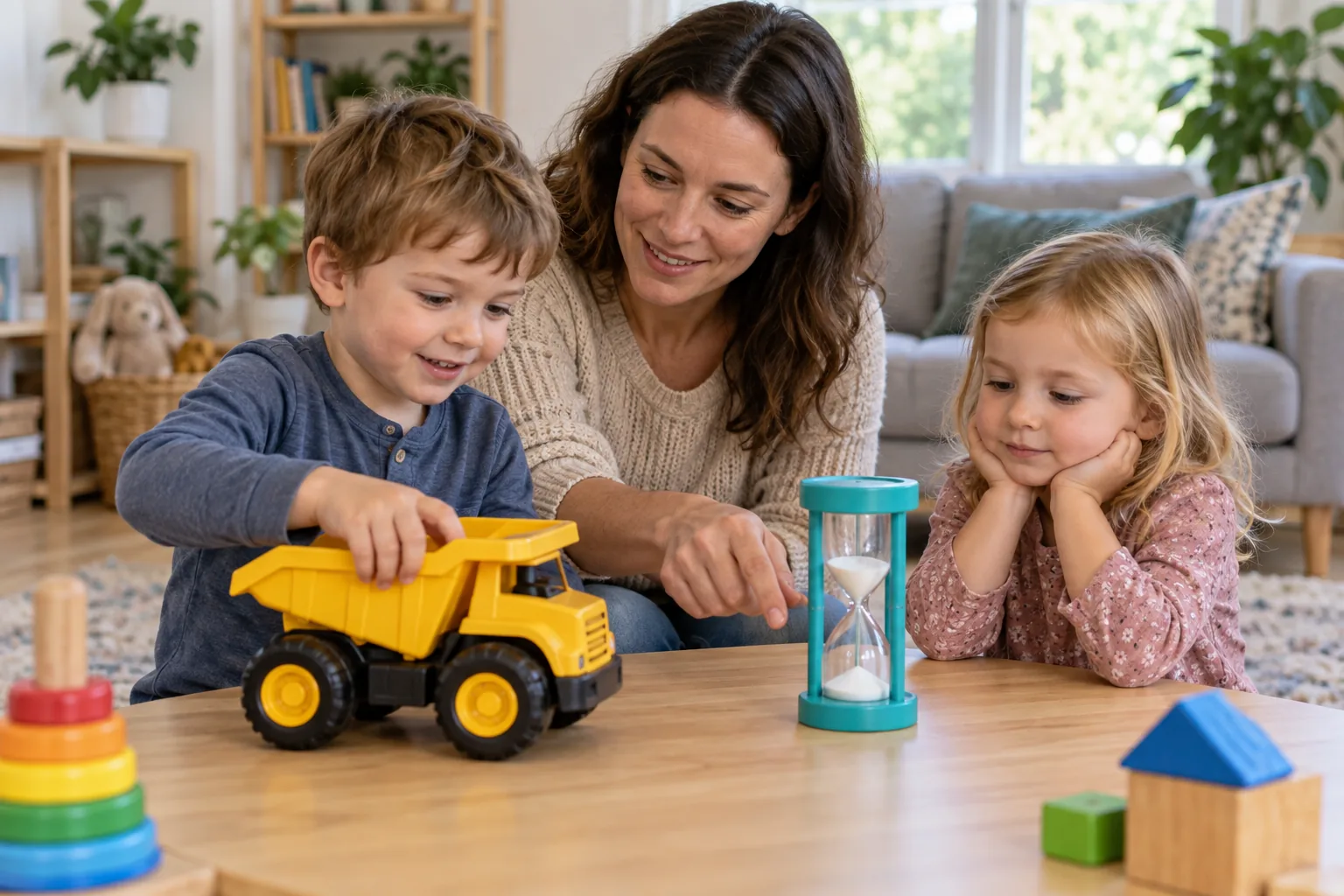
Describe what you see calmly: “You both want the red car. Mia is using it now.” A child who has just begun a meaningful game may need time to finish. ZERO TO THREE suggests that a longer turn can sometimes work, with an adult helping the waiting child find something else to do. In other situations, an agreed timer or clear finishing point may be more practical. ZERO TO THREE: Helping young children with sharing
“Soon” can be hard to understand. “When this road is finished” gives a visible endpoint. Constantly switching a toy every few seconds can interrupt the very play you want to support. Agree on the arrangement before conflict when possible. Taking the toy immediately from one child simply because the other cries can make fairness harder to understand.
If pulling, pushing or hitting begins, protect the children first. Create space and state that grabbing or hurting is not allowed. Do not decide turns through a contest over who cries loudest. Acknowledge both feelings and return to a solution after the intensity settles. Safety is the foundation for sharing practice. ZERO TO THREE: Helping young children with sharing
Practise with ordinary enjoyable activities
Roll a soft ball back and forth, add puzzle pieces in turns, or take turns placing socks in a laundry basket. Keep the wait short and visible at first. ZERO TO THREE discusses reciprocal play and everyday jobs as ways to practise cooperation. Enjoy the shared action rather than testing whether your child has reached a developmental standard. ZERO TO THREE: Learning to cooperate
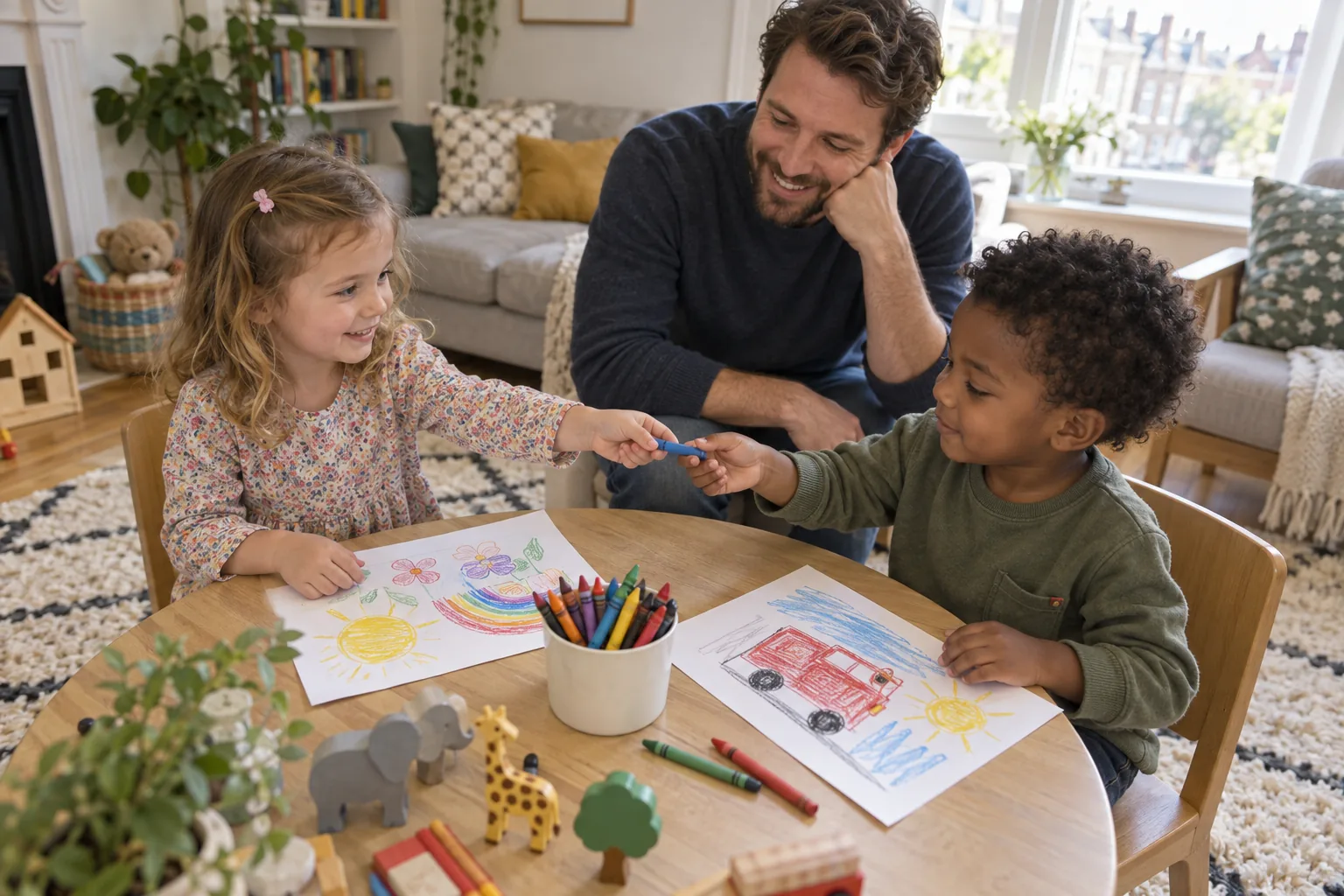
Two children making one picture could choose different parts: one draws clouds and the other flowers. If both want blue, they can discuss starting with another colour or passing it after completing a section. These are original practical examples, not guaranteed interventions. Use materials suitable for the children’s ages and avoid small parts that pose a choking risk.
Notice the action rather than a fixed trait: “You passed the blue crayon when you finished; that helped your friend complete the sky.” Model asking before borrowing something from your child, too. Small appropriate choices can make cooperation feel like working together rather than simply obeying the larger person. ZERO TO THREE: Learning to cooperate
Adjust the setting and know when to seek support
A shorter playdate, a time away from hunger or exhaustion, and more than one appealing activity are reasonable family experiments. You do not need to buy two of everything. Playing alongside another child with different materials can be a useful start. Avoid repeatedly labelling one sibling generous and the other selfish; look at the support each needs today.
Difficulty sharing by itself does not diagnose autism or another condition. Seek advice from a paediatrician if distress or aggression persistently disrupts play and daily life, or if you also have concerns about communication, development or lost skills. Address injury risks immediately. A social setting offers opportunities to practise, but it cannot replace an individual assessment when one is needed.

Did you know?
Cooperation is more than doing what an adult says. It includes balancing needs while working towards a shared goal. Offering small appropriate choices can bring that experience into daily family tasks. ZERO TO THREE: Learning to cooperate
Frequently asked questions
Is my two-year-old selfish for refusing?
Not on the basis of this behaviour alone. Toddlers are learning waiting, ownership and emotional regulation. Short turn-taking games and nearby adult help are more useful than a character label. A child can manage one successful exchange and still find the next one difficult.
Should I take the toy and hand it to the other child?
Without a safety reason, do not make forced surrender your standard sharing lesson. Clarify whose turn it is and how it will end. Put precious personal belongings away beforehand. Shared materials need a fair arrangement, and physical grabbing needs an immediate calm limit.
Do we need a timer?
No. It can make a turn visible in some situations and unnecessarily interrupt others. Finishing a structure or a round can be a natural endpoint. If you use a timer, agree beforehand and make the process equally clear for both children.
What if the waiting child cries?
Stay nearby and acknowledge disappointment: “Waiting is hard; you really want that.” Offer another safe activity. Rather than changing turns solely to stop tears, keep the agreed arrangement and adjust the length or setting for the next attempt if necessary.
Should the older sibling always give way?
No. Being older does not mean giving up every possession or turn. Both can have personal items and fair access to shared things. Adults should help the younger child wait rather than making the older sibling a permanent mediator or substitute caregiver.
Do hugs and food belong under the same sharing rule?
Body boundaries and food safety need separate consideration. Do not force hugs or kisses. Respect allergies and hygiene, and do not use sharing a drinking cup as a generosity lesson. A toy-turn rule should not be applied automatically to every part of life.
What if my child wants a stranger’s toy at the park?
Model asking permission and accepting a no. “That belongs to them; they might want to keep using it. We can find something else.” Learning that their own belongings have boundaries can go alongside respecting another child’s decision.
When should we ask a professional?
Ask if severe distress or conflict consistently interferes with everyday functioning, especially with additional communication or developmental concerns. Bring concrete examples. One refusal to share cannot establish a diagnosis; a professional considers the child’s wider pattern and needs.
Related reading
- When a Child Struggles Socially
- Helping your child find their voice in Istanbul: Turkish and the language of home
Sources
- ZERO TO THREE: Helping young children with sharing
- Raising Children Network: Sharing
- ZERO TO THREE: Learning to cooperate
For general information; this does not replace an individual assessment.