My Child Refuses Toothbrushing: Find the Uncomfortable Step First
Your child may happily choose a colourful toothbrush and then clamp their mouth shut as soon as brushing begins. That does not tell you whether the problem is taste, touch, pain or leaving a favourite activity. Effective cleaning still matters. The useful next step is to identify the difficult part and make the routine more manageable, rather than treating every refusal as deliberate defiance.
Check for discomfort before changing the rules
A sudden refusal after previously comfortable brushing deserves attention. Notice mouth sores, a painful tooth, sensitivity, an injury or chewing mainly on one side. Do not force the mouth open to conduct an elaborate home examination. Describe what you have observed to a dentist, especially if eating or sleep has changed.
Sensory differences can also affect brushing. Strong mint, foam, vibration or the feel of bristles may be difficult. This observation alone does not establish a developmental diagnosis. Birmingham Community Healthcare NHS describes adjustments such as considering taste and foam while keeping an effective dental-care routine. [4]
Change one variable at a time
Try a smaller suitable brush head before changing every part of the evening. On another occasion, discuss an appropriately fluoridated, less strongly flavoured toothpaste. If location, product, timing and helper all change at once, it becomes hard to learn what helped. Ask a simple question, and accept that a young child may answer through behaviour rather than words.
A phrase that keeps the task clear
“We are cleaning your teeth. You can start, and I will finish the places that need help. Would you like the blue brush or the green one?” The choice is about participation, not whether oral care happens. Offer only products that are actually suitable for the child.
The basic cleaning framework
Begin when the first tooth appears. NHS guidance recommends brushing twice daily for about two minutes with fluoride toothpaste, including last thing before bed. Use a small, soft brush and adult assistance appropriate to the child’s ability. Holding a toothbrush independently is not the same as cleaning every surface effectively. [1]
The ADA advises a rice-grain-sized smear for children under three and a pea-sized amount from three to six. An adult should dispense it and keep the tube out of reach between uses. Discuss fluoride concentration and individual decay risk with your dentist rather than choosing only by flavour or packaging. [2]
Spitting and rinsing
Encourage children who can do so to spit out excess paste, without rinsing immediately afterwards. NHS guidance uses toothpaste containing at least 1,000 ppm fluoride for under-threes unless a dentist advises otherwise. Younger children who cannot spit need particular attention to the very small amount and adult supervision. Do not add supplements or high-strength products without advice. [3]

Build the routine around a manageable transition
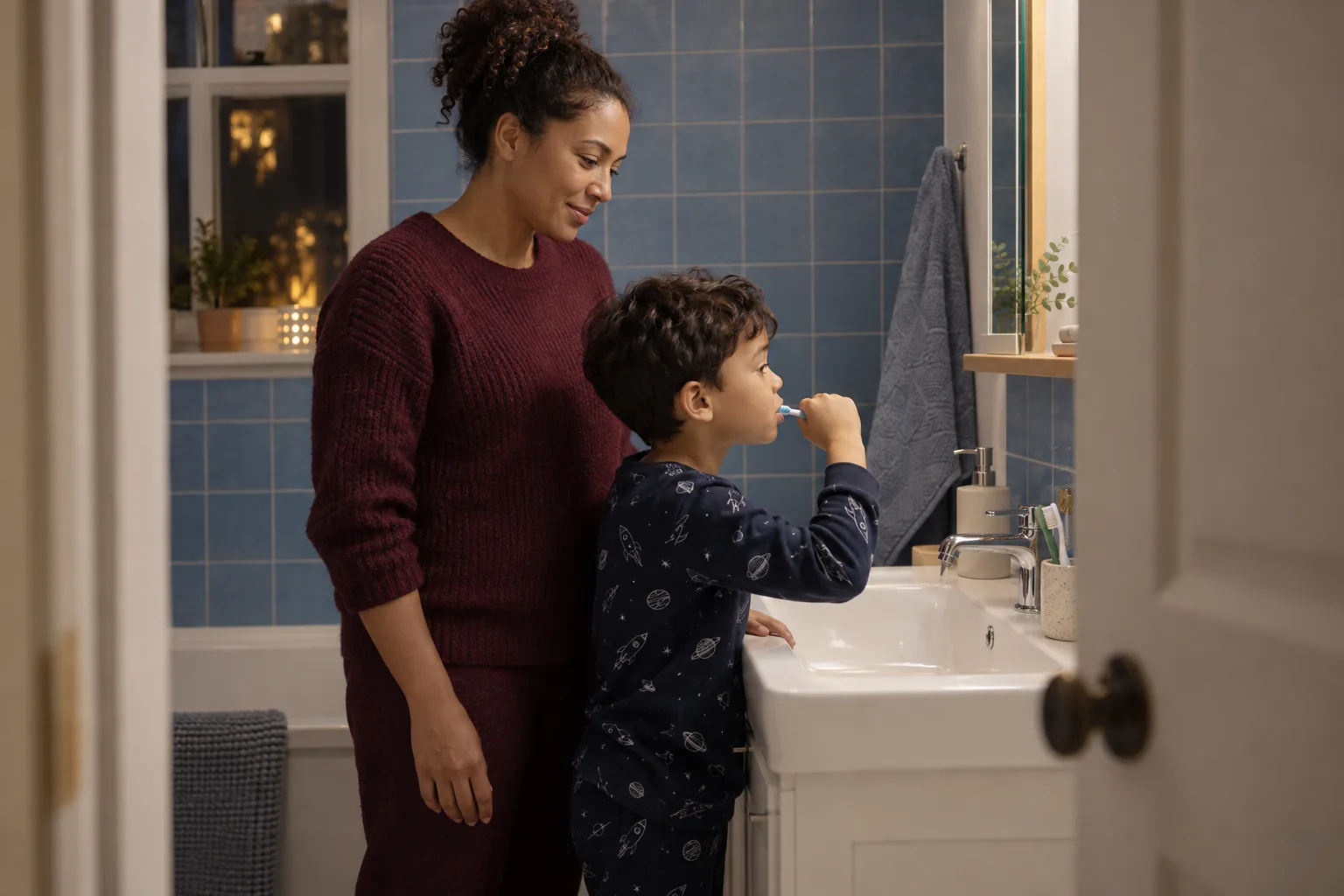
Give a short warning before leaving play: “After this page, we will brush.” Avoid reserving the task for the moment your child is already exhausted. Provide safe access to the sink and do not let them walk or run with a brush in their mouth. A stable position where you can see the teeth helps more than chasing around the bathroom.
A song or timer can make the sequence predictable, but the purpose is not simply to wait out two minutes. Clean the inner, outer and chewing surfaces, and finish the areas your child cannot manage. Brushing alongside them can show what you mean. Keep the order simple enough that the routine does not collapse when one favourite song is unavailable.
For a child who needs to get used to the sensation
During a calm moment, let them hold the brush, look at it in a mirror and become familiar with gentle contact. These small practice steps do not permanently replace adequate cleaning. If brushing remains impossible, seek an individual dental plan rather than spending weeks hoping that exposure alone will be sufficient.
Keep travel practical
Families living in or visiting Istanbul may move between homes with different bathrooms. Carry the familiar brush and suitable paste, and decide which adult will help. Do not make a tired child responsible for remembering every step simply because the routine has been explained before.
Did you know?
Baby teeth matter for comfortable eating and speaking as well as the space they hold for later teeth. Their eventual loss is not a reason to ignore pain or decay. The frequency of sugary food and drink exposure also belongs in a dental-care discussion, not just the total amount of sugar. [3]

When to get help
Arrange dental advice for pain, persistent bleeding, visible decay, eating difficulty or a routine that cannot be carried out. Suspected infection, especially with facial or jaw swelling or fever, needs prompt dental assessment. Difficulty breathing or swallowing, or substantial swelling in the mouth, requires emergency help. Do not label these signs as a behaviour problem. [5]
Frequently asked questions
Should we switch to fluoride-free paste if my child swallows it?
Review the amount, product and supervision with your dentist. Occasional swallowing by a young child does not automatically mean stopping fluoride toothpaste. An adult should place the small age-appropriate amount on the brush and keep the tube away afterwards.
When can my child brush completely alone?
Ability matters as well as age. NHS advice recommends help or supervision until at least seven, and some older children still need support. Check whether all surfaces are reached and whether the child can use the appropriate amount safely.
Is an electric toothbrush essential?
No. A suitable manual brush can also clean effectively. Some children enjoy vibration and others find it unpleasant. Age suitability, comfort and regular effective use are more useful selection criteria than price or the number of special features.
What if two minutes feels impossible?
Identify the difficult step and work on manageable progress, while seeking advice if cleaning remains inadequate. Do not accept a few seconds as a permanent solution without dental guidance. Explain honestly what you can and cannot currently do.
Can sweets be a reward for brushing?
A sugary reward conflicts with the purpose of the routine. A simple mark on a chart, choosing the next book or noticing a specific effort may suit your child better. Affection should never depend on brushing performance.
Can mouthwash replace the brush?
No. Mouthwash is not a substitute for cleaning teeth and may be unsuitable for young children who swallow it. Ask a dentist before adding a product. A difficult routine needs a workable cleaning plan, not an automatic replacement with a rinse.
Should I warn that the dentist will be cross?
Threats can make future care harder. Present the dentist as someone who helps teeth feel and work well. If your child has had a frightening experience, tell the team in advance so the visit can be planned with that in mind.
Have we failed if one evening goes badly?
One disrupted evening does not define the whole routine. Return to the next cleaning without a long blame-filled discussion. If missed sessions become frequent, review timing, pain, products and the amount of adult help rather than assuming more reminders will solve it.
Related reading
Sources
- NHS — Children’s teeth
- American Dental Association — Toothpastes
- NHS — Baby and toddler tooth care
- Birmingham Community Healthcare NHS — Oral health advice for children with sensory issues
- NHS — Dental abscess
Sources checked on 26 September 2026. This article offers general information and does not replace an assessment of your child.