
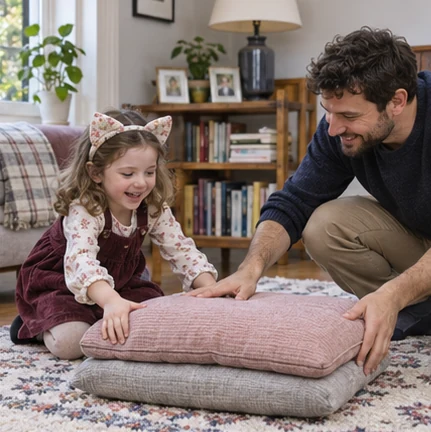
Your child crouches next to a cushion, raises both hands like paws and meows when you ask what they are doing. Perhaps they want you to join their story. Later, the same sound might crop up when you ask them to put shoes on. Look at the moment around the meow. It gives you a better idea of whether to play along, set a boundary or help them make a transition.
Follow the play while there is time for it
You can offer a folded cushion as a pretend cat bed, then let your child tell you what happens next. If they want to play alone, a smile or a brief comment can be enough. The American Academy of Pediatrics describes pretend play as a way for children to invent roles, give familiar objects new meanings and share ideas with other people.
Use a short ending when you need to leave. “One more cat stretch. Then we’ll put your shoes on.” If the hallway is clear, they can walk to the door like a cat and still get ready on time. Keep ordinary rules visible: drinks go in the usual cup and children stop before crossing the road. You can interrupt straight away if someone might get hurt.
Look at more than how often they meow
A favourite character can recur for several days. Notice whether your child also joins other games, shows you what they need and responds to changes when prepared. Rather than asking them to switch roles as a test, note a few everyday examples. “She meowed when I asked for her coat, then got it after the cat went to bed” gives more context than “She was a cat for an hour.”
The CDC uses pretending to be something else during play as an example of a milestone at age four. Cat play itself does not diagnose autism or any other developmental condition. If it regularly interferes with eating, leaving home or taking part at nursery, or you have wider concerns about communication, share the examples with your child’s health professional. Seek advice promptly if your child loses words, gestures or other skills they used before.
Frequently asked questions
Should I insist they answer in words?
During play, a meow may be the answer they intended. When you need to understand a request, model a word, sign or gesture they can use and wait for their response.
Is one favourite role a problem?
A favourite role alone tells you little. Look at how your child manages other activities and expresses needs across the day.
Can I keep cat play to one part of the house?
Yes, if that helps with noise or safety. Agree on a space and give a short warning before the game has to end.
What should I ask the nursery?
Ask when the play begins, whether other children join and what makes it easier to move to the next activity.
What if my child wants everyone to be a cat?
You can accept or decline an invitation. Try “I’ll be the vet for a minute, then I need to make dinner.” It gives the game a place and a finish.
Sources
Türkçe · Deutsch · English · Français · 简体中文 · 日本語 · 한국어 · العربية
Bir yanıt yazın