
It can happen while you are getting a feed ready, five minutes after a feed, or in the middle of a happy kick on the mat. Hands going to the mouth have more than one context. Looking for the signals that accompany the movement helps you decide what to do next.
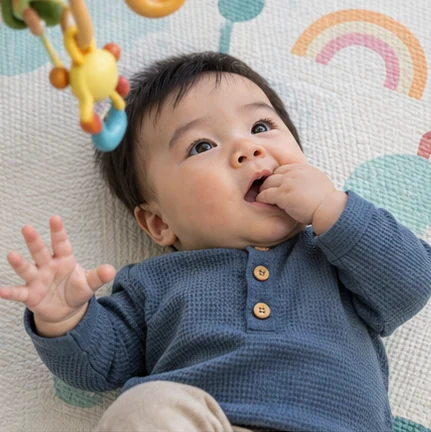
Does your baby show a cluster of feeding cues?
For babies under about six months, the CDC includes bringing the hands to the mouth among possible hunger cues. It also describes turning towards the breast or bottle and making small movements with the lips. Picture your baby stirring after a nap, flexing their fingers and turning towards the bottle as you lift them. Taken together, those actions can help you respond before crying begins.
The same CDC developmental programme gives hands-to-mouth movement as one example around four months. A baby playing with their hands while looking at you and stretching may be exploring. That context is different from a baby turning to seek a feed.
Follow the response after you offer
A calm offer of a feed can give you more information than checking the clock alone. When your baby turns away, keeps their mouth closed or relaxes after feeding, pause and observe. A baby sucking a hand after feeding may be doing something else with the sensation. Keep track of feeding patterns, alertness and wet nappies if you are concerned about how much milk they take.
- Look at the hands in daylight. Remove visible dirt with ordinary washing. Do not apply bitter or strongly scented products to stop the movement.
- Look at the play space from floor level. Move small parts and cords away from where your baby can reach.
- Tell the clinician about changes, not just the action. Describe whether feeding is less effective, whether there are fewer wet nappies than usual, and when the pattern started.
Poor feeding or reduced wet nappies warrants prompt advice, especially if new or persistent. Use emergency services if your baby has trouble breathing or cannot be roused normally.
Frequently asked questions
Does it count as a hunger cue after every nap?
It may be one clue. See whether your baby also roots, turns towards the feed or shows their other usual feeding signals.
Is it a sign of teething?
Hand sucking alone does not establish that teeth are coming. Your baby may simply be exploring.
Should I put a toy into their hand instead?
An age-appropriate toy is an option during supervised play. There is no need to interrupt comfortable hand exploration.
What if my baby keeps sucking after turning away from the bottle?
Allow a pause. Babies can show signs of fullness even while continuing a hand movement. Speak to your health team if you are worried about intake.
Is hand sucking the same as readiness for solids?
No. Ask your clinician about readiness for complementary foods and use guidelines appropriate to your baby’s age and development.
Sources
Türkçe · Deutsch · English · Français · 简体中文 · 日本語 · 한국어 · العربية
Bir yanıt yazın