
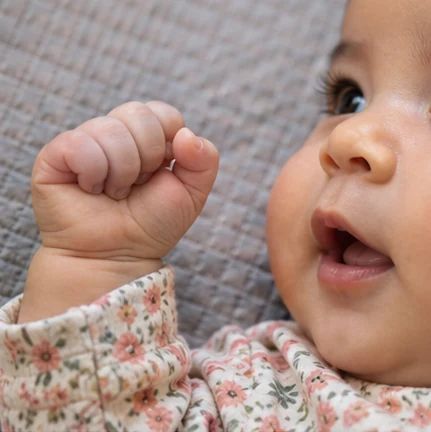
A baby’s grip can surprise you. You brush a palm and the fingers curl around yours as though they have no plans to let go. Later, at play, the same hand may open for only a moment. In the early months, watch what the hands do over time and compare how your baby uses each side.
A reflex that can be felt in your own hand
The palmar grasp reflex is the closing of a newborn’s fingers when the palm is touched. The American Academy of Pediatrics describes it as present at birth and fading during the first half-year. Newborns can also rest with their fingers curled when nothing is in the palm. That resting position and a grip prompted by touch are two different observations.
Early hand use grows more varied. The CDC lists briefly opening the hands among examples at two months and holding a toy placed in the hand around four months. The checklist is useful preparation for a visit. It cannot tell you from one brief observation which movements a baby can make in different situations.
Observe both hands without making it a test
Choose a time when your baby is comfortably awake. On a firm floor play mat, watch them bring a hand towards their mouth or bring both hands towards the middle of the body. A finger may uncurl when they look at your face, then curl again during a kick. Let the movement happen without pulling the fingers straight.
- Notice position. Does the hand look different when the arm is raised or relaxed?
- Watch the other side. Does one arm seldom lift? Does the same hand repeatedly stay closed when the other one reaches?
- Keep the timeline. Write down when you first saw each contrast and whether it occurs in several situations.
A clear left–right difference, ongoing stiffness, pain or a loss of a skill is worth discussing promptly with your child’s clinician. You can say “For a week I’ve seen the left hand stay closed during play while the right reaches for toys.” That gives the clinician a better place to start than the phrase “clenched fists”.
Frequently asked questions
Do fists always mean my newborn is hungry?
They can appear in many situations. Look at early feeding cues such as turning towards touch and making sucking movements alongside your baby’s usual feeding pattern.
Can babies grip strongly before they can reach for toys?
Yes. A touch-triggered grasp is present before voluntary reaching is well established.
What if my baby fists both hands during a noisy moment?
Notice whether they relax and open again in quieter play. Ask for advice if stiffness persists across ordinary situations.
Should I massage the fingers open?
Let an awake baby move freely. Avoid forcing the fingers back. If opening the hand seems difficult or painful, ask a clinician to assess it.
What if my baby clearly favours one hand very early?
Tell the clinician which actions show the pattern. Persistent early preference or weakness on the other side warrants assessment.
Sources
Türkçe · Deutsch · English · Français · 简体中文 · 日本語 · 한국어 · العربية
Bir yanıt yazın