
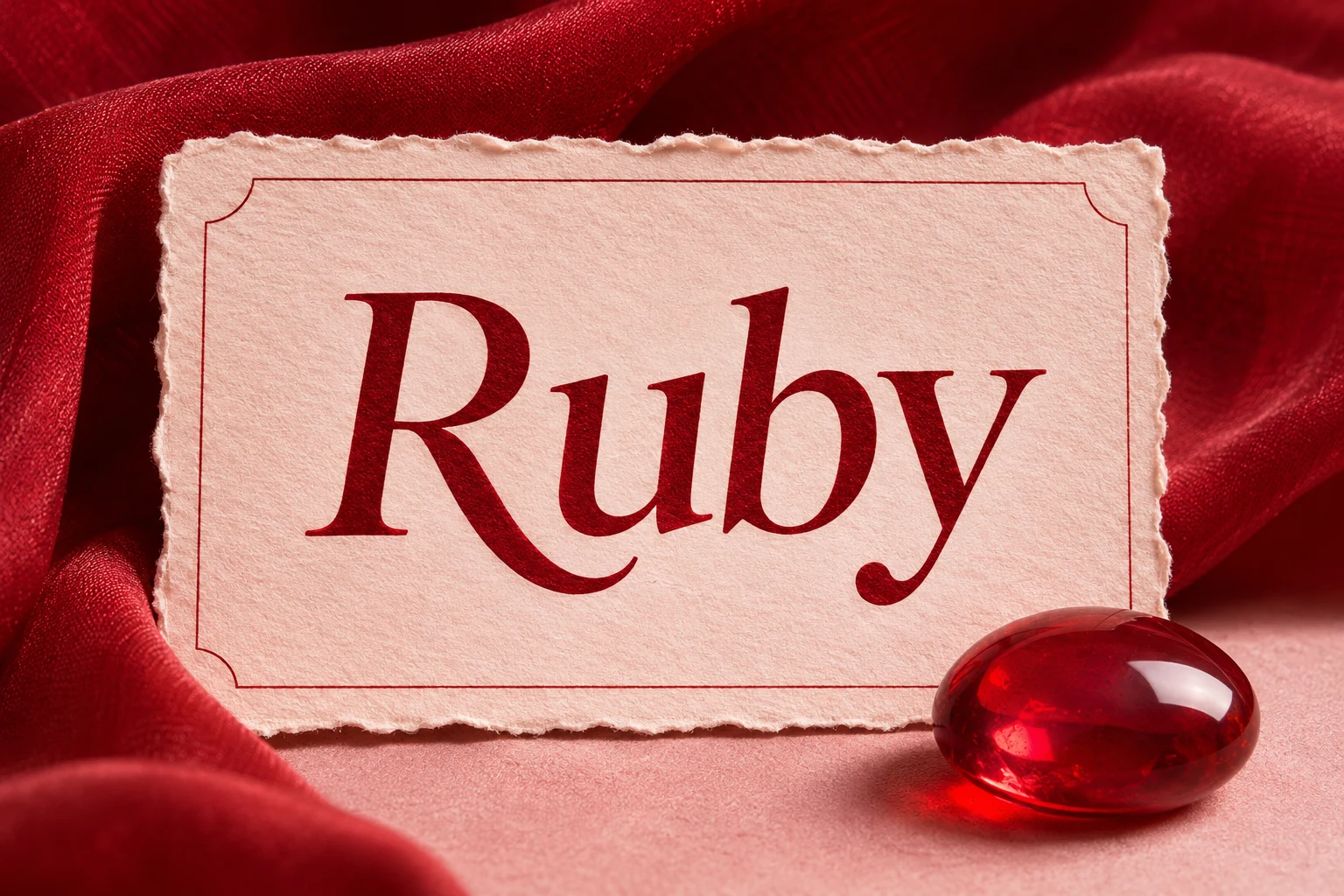
Ruby brings a strong colour image to mind, but a child's name is more than a decorative theme. Parents considering Ruby often want to know whether it means the stone, whether a birth month matters and what the letters produce in numerology. Here you will find the word history, practical naming questions and playful cultural ideas without promises about a child's character or future.
What does the name Ruby mean?
Behind the Name traces the given name to the precious stone. The word route passes through Medieval Latin rubinus and ultimately Latin rubeus, associated with red. That is a history of the word; it is not evidence that a Ruby will have a fiery temper, particular appearance or an expensive lifestyle.
A gemstone connection can be meaningful even if a family owns no gemstone and has no jewellery tradition. You may simply enjoy the sound or the colour. There is no need to invent a long family legend to make the choice feel worthwhile.
Does Ruby have to be born in July?
Ruby is traditionally associated with July as a birthstone, as the name source notes. A symbolic calendar association does not restrict the name to babies born that month. It also cannot prove when a particular Ruby was born.
If the month matters to your family, describe it as your chosen connection. If it does not, a red paper detail on a keepsake is enough. Neither birthstone traditions nor decorative colour choices provide information about health, luck, wealth or compatibility.
Spelling Ruby in everyday life
This article uses four letters: RUBY. The final Y is a full letter in the calculation. It is not removed because it may represent a vowel sound. Ruby and a spelling such as Rubie may sound similar to some speakers, but they are different written inputs.
Say Ruby aloud with the surname and any second given name. Notice how you prefer to introduce it, rather than asking strangers to score whether it sounds strong or successful. Those judgements can turn a simple preference into pressure. The child will have their own relationship with the name over time.
Ruby's Latin-letter number calculation
This page calculates the given name only using a modern Western Latin-letter convention: A–I receive 1–9, J–R repeat 1–9 and S–Z receive 1–8. Spaces, hyphens and accent marks are removed. Intermediate sums continue to one digit. This is neither a birth-date life-path calculation nor a full-name calculation; the modern 26-letter chart is not attributed to ancient Pythagoras.
Ruby → Ruby → RUBY
Letter values: R(9) + U(3) + B(2) + Y(7)
Sum and reduction: 21 → 3
RUBY totals 21 and reduces to 3. This result is easy to audit because all four letter values are shown. Nothing about the stone's price, colour intensity or a date of birth enters the arithmetic.
Three is sometimes given expression or creativity themes in modern symbolic writing. A family could make a three-colour collage or record three favourite stories. Those are chosen activities, not tests of whether Ruby is naturally artistic. Enjoying maths, quiet play or no particular colour is equally compatible with having the name.
Personality and future: leave the gemstone metaphor open
“Precious to us” can be a loving family message. “You must sparkle all the time” gives a child a performance to maintain. When using gemstone imagery, choose language that allows ordinary sadness, shyness and changing preferences.
The same applies to future interpretations. Ruby does not predict a career in the arts, a luxurious life or romantic success. A name can be the title of a memory book; it does not write the chapters in advance. Record real interests and choices as they emerge instead of fitting them to a gemstone personality.
Ruby and the twelve zodiac signs: twelve keepsake prompts
These are optional cultural conversation themes, rather than observed traits of a child. No sign is ranked as better or worse for the name. Scientific evidence does not establish reliable personality prediction from birth charts.
- Ruby · Aries: Begin a Ruby keepsake with a first remembered smile or question; a beginning theme does not prove courage or leadership.
- Ruby · Taurus: Compare red paper, fabric and painted shapes for the cover; tactile design does not mean Ruby must prefer luxury or comfort.
- Ruby · Gemini: Invite two different descriptions of the colour red and keep their contrast; this is a language game, not a social forecast.
- Ruby · Cancer: Pair Ruby's name with a family memory that feels welcoming; warmth is an adult message rather than the child's caregiving duty.
- Ruby · Leo: Use a bold red frame around a simple name card; a bright design does not require its bearer to enjoy attention.
- Ruby · Virgo: Count the four written letters including Y and make a careful label; neatness in a layout is no personality assessment.
- Ruby · Libra: Balance a red shape with a colour Ruby might choose later; aesthetic balance does not impose harmony in every relationship.
- Ruby · Scorpio: Store a note about why the gemstone image appealed to your family; symbolism cannot reveal private traits or hidden destiny.
- Ruby · Sagittarius: Invent a route to a storybook red-stone island; adventurous fiction does not predict travel or a particular adult lifestyle.
- Ruby · Capricorn: Build a three-panel memory page from the number calculation; completion is a design theme, not a duty to achieve.
- Ruby · Aquarius: Let the child replace a traditional gemstone motif with an unexpected picture; a different choice does not need an astrological explanation.
- Ruby · Pisces: Imagine a red reflection in a quiet illustrated pond; poetic colour offers atmosphere without predicting sensitivity or emotional patterns.
Did you know?
A word can have both an everyday object meaning and a personal-name use. Learning where the word Ruby came from does not explain every family's reason for choosing it. A relative's name, a favourite sound and a gemstone reference can coexist without being the same story.
Likewise, a red cover illustration can express a visual idea without making a claim about the child. There is no requirement to buy a real stone, wear a certain colour or follow a birthstone custom. A drawn red shape can carry the family message just as well.
Make a Ruby name page without a personality label
Start with the exact spelling at the top. Under it, place three short notes: the sourced word history, your family's choice and a question for the future bearer. “What colour would you choose for your page?” invites a real answer instead of assuming red will always be the favourite.
For a family with more than one child, avoid assigning one a ruby role and another a diamond or gold role as a value ranking. A metaphor should not become a comparison of who is more precious, bright or successful. Each page can use a different design while expressing equal affection.
It can also help to write a pronunciation cue for relatives who use another language. Offer the cue as assistance, not as a correction of their whole accent. Personal names are everyday forms of address, and the person's own preference matters more than a decorative theme.
Frequently asked questions about Ruby
Does Ruby mean the gemstone?
Yes. The name is derived from the word for the precious stone, with a word history ultimately connected to Latin for red.
Is Ruby only suitable for July babies?
No. July is a traditional birthstone association, not a naming requirement and not a way to identify an individual's birthday.
What is Ruby's numerology result?
RUBY gives 21→3 in the displayed modern Latin-letter system. The final Y is included.
Does Ruby promise wealth or good luck?
No. A gemstone name does not establish financial prospects, luck, health or the value of the person who bears it.
Are Ruby and Rubie the same calculation?
They are different letter inputs. Similar pronunciation does not make their sums interchangeable.
Will Ruby be creative because the result is three?
That cannot be concluded from the name. Creativity is used here as an optional theme for a family activity.
Which zodiac sign is best for Ruby?
No sign makes the name or child better. The zodiac section supplies twelve alternative creative prompts.
How can we use the gemstone idea respectfully?
Use it as a message of affection rather than a demand to be glamorous, cheerful or outstanding. Let the child choose their own colours and interests.
Bir yanıt yazın