
A child may remember a calming song and still need a trusted adult when upset. That is a useful starting point for watching Daniel Tiger’s Neighborhood. This guide treats the programme as a possible conversation starter, not a model of a perfectly regulated child. A disagreement over whose turn comes next can become a small moment to practise listening without expecting an instant change.
Story and characters
Daniel Tiger and his friends encounter everyday experiences involving feelings and relationships.
Daniel Tiger; Katerina Kittycat; O the Owl; Prince Wednesday; Miss Elaina.
What can a child explore?
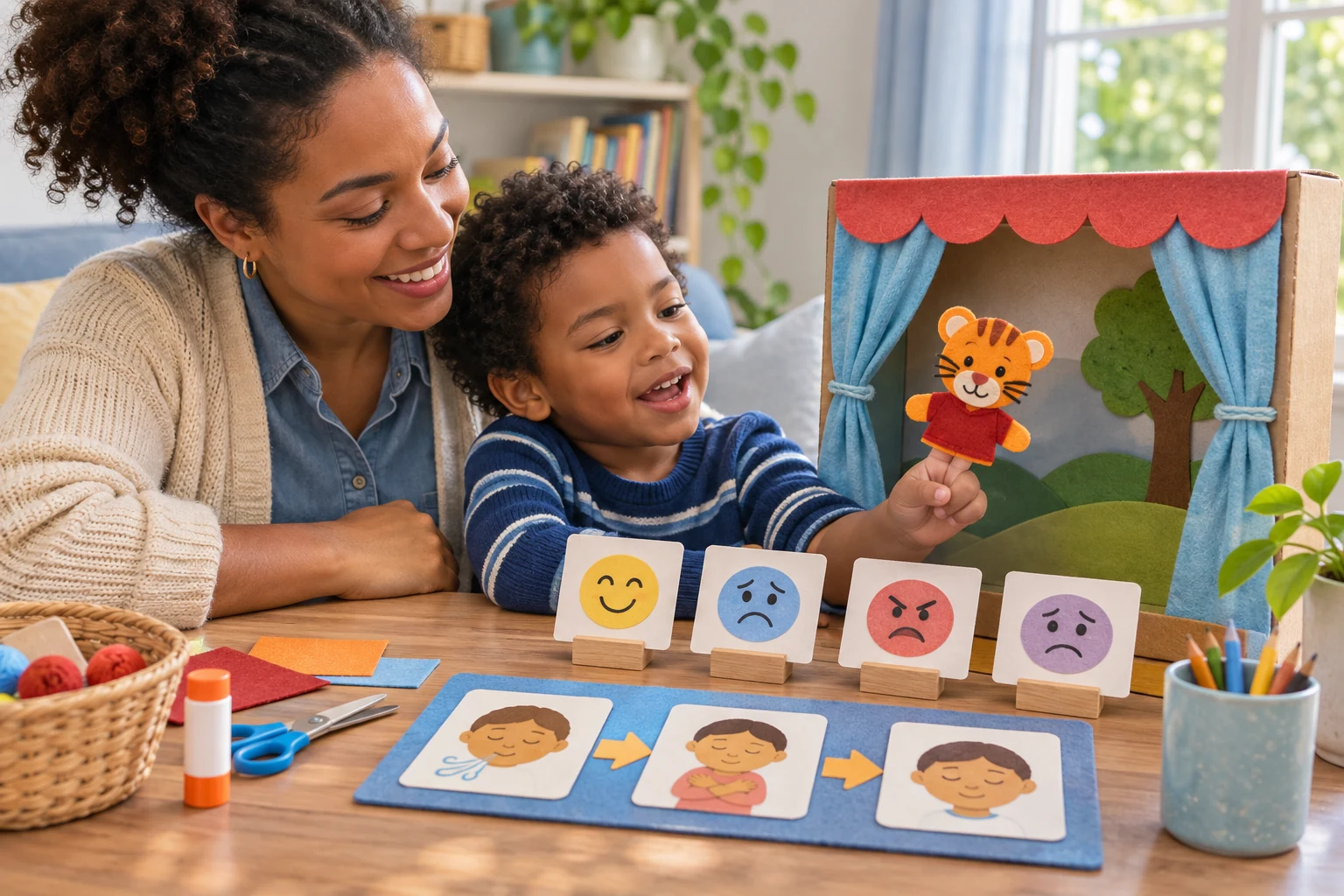
Instead of asking for the right emotion word, ask what the child thinks happened. Their interpretation may differ from yours. In a toy version of the disagreement, let the child suggest a pause, a different arrangement or help from another character. A remembered song can be a cue, but repeating it accurately does not demonstrate independent use of the strategy. Keep the role-play short enough that it remains play.
Feelings, behaviour and boundaries
Avoid comparing the child with Daniel in the middle of distress. Accept the feeling while setting a clear boundary around hurting someone. Do not promise that every hard moment will be solved by a song or that more episodes are the answer.
Expertise and the limits of evidence
A programme's educational intention, an adviser’s contribution, an expert opinion and a study with children are different kinds of evidence. The source below is interpreted within its own limits.
Eric Rasmussen’s research account highlights regular parent–child conversations in interpreting Daniel Tiger findings. Eric Rasmussen and colleagues, Texas Tech research account.
A result under particular study conditions is not a guarantee for every viewer, season or developmental need. This guide does not present the programme as treatment.
An activity away from the screen
- Give two toys one wanted object.
- Let the child invent both feelings and possible solutions.
- Try a different ending without scoring either response.
This is an editorial family-play suggestion, not an official lesson or a therapeutic programme. An adult should choose suitable materials and a safe setting.
A realistic family viewing plan
Choose one episode before pressing play and agree on a stopping point. During viewing, avoid turning every scene into a test. Pause if something is confusing or uncomfortable. Afterwards, ask which detail the child remembers, rather than requiring a correct account of the plot. Moving straight to another kind of play is also a valid choice.
For several days, notice what happens around viewing: how stopping feels, whether bedtime slips and whether there is still space for meals, movement and conversation. One difficult evening is not a diagnosis or a personality description. Persistent distress that disrupts everyday life deserves a conversation with the child's healthcare professional.
Frequently asked questions
Does remembering a strategy mean a child can use it?
Not necessarily. Recall, understanding and using it during a difficult moment are different. A calm toy game can open a conversation without testing the child.
Must we sing the songs exactly?
No. The family can use its own words. A supportive response matters more than a perfect performance.
What if my child behaves unlike Daniel?
A fictional character is not a developmental scale. Listen to the child's actual experience rather than using the character as a comparison.
Does co-viewing have to become a lesson?
No. One open question can be enough, and the child may prefer to move to another activity.
What age is it suitable for?
The intended audience is not an individual readiness assessment. Check the current local rating, the particular episode and whether your child follows the story comfortably.
How many episodes a day?
There is no single episode count for every family, and running times differ. Protect space for sleep, movement and human interaction; discuss individual concerns with a healthcare professional.
Is protesting when it ends a sign of addiction?
A single protest is not a diagnosis. Explain the stopping point beforehand and make the next activity concrete. Seek support if the difficulty persistently disrupts everyday life.
Can the programme replace psychological support?
No. Characters can open a conversation, but they do not replace an assessment of a child's distress, communication difficulties or developmental needs.
Sources and method
- PBS KIDS: Daniel Tiger
- Eric Rasmussen and colleagues, Texas Tech research account
- Prosocial TV and app experiment, 2018
Sources checked 29 November 2026. This guide uses official descriptions and the research identified below; it does not claim a scored viewing of every season. Dubbing, ratings and access vary by region. The article has not undergone specialist clinical review.
Bir yanıt yazın