
A paper river needs a crossing, but there is no model to copy. A low block bridge lets parent and child try an idea, observe a wobble and change one feature. A collapse can be information rather than failure.
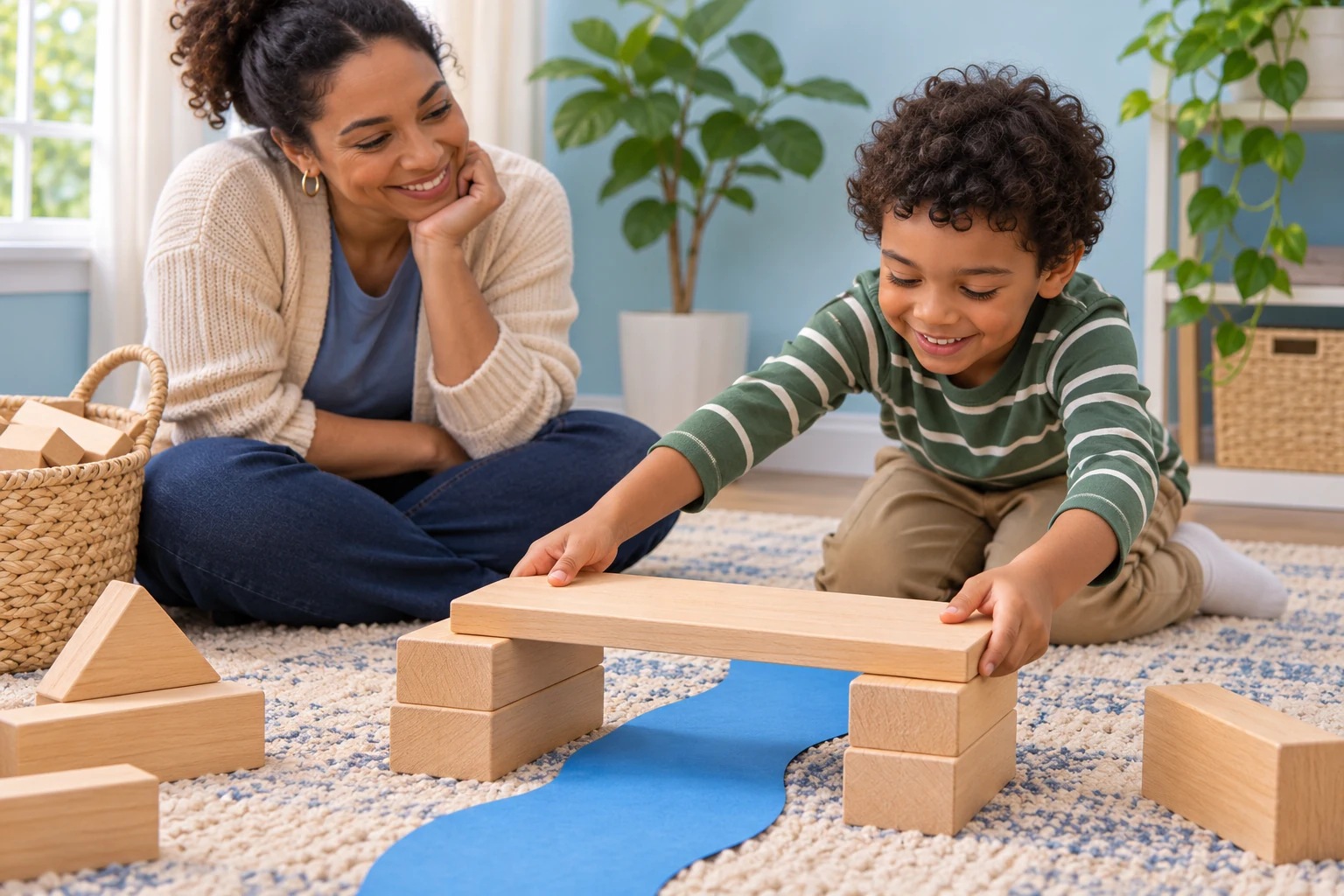
Materials and setup
Large blocks, a wide bridging piece and blue paper on a flat surface.
How to play, step by step
- Place low supports on either side of the paper river.
- Let the child choose a piece to span the gap and predict what will happen.
- Try a light toy on the bridge, then change just the support distance.
Adjusting age, pace and participation
Ages and timings here are starting suggestions, not developmental tests. Choose a shorter round when that suits your child; completing a set duration is not the aim.
- A simpler start: For ages 3–4, begin with two supports and one broad piece, building together if wanted.
- A next step: For ages 5–8, compare gaps without adding height or a heavy-load competition.
- Another way to join: Choosing pieces and describing where they go can be separate roles at an accessible table.
What children get to practise
Position, width and support become visible topics for conversation. A structure does not predict a future engineering career.
Expert source and research limits
Verdine and colleagues studied assembly–mathematics associations, not causal gains from this bridge.
The source below did not test this exact home version. The educational suggestions are editorial adaptations, not an independent expert review of this article. No increase in IQ, school achievement or psychological health is promised.
An educational approach for parents
After a fall, notice which part moved before rebuilding it for the child. Offer to steady one support if requested, leaving the overall design in the child's hands.
Demonstrate a small part of the game, then let your child try. Resist narrating every move. Offer help at the point where it is wanted, rather than doing the whole task. A useful adult role is to make room for the child's choice, including the choice to lead the next round.
A mistake need not cost points or remove someone from play. Simplifying a rule, trying together or stopping are all options. Looking away does not, by itself, reveal a developmental problem. This activity is neither a score for your child's worth nor a test of how well you parent.
Plan the next round together
At the end, ask which part was enjoyable and which was awkward rather than counting correct answers. Choose one adjustment for next time: fewer materials, a longer pause or a different role. Repeating exactly the same version is also a reasonable choice.
Did you know?
Changing only one feature can make a challenge easier to understand. Increasing speed, materials and rule complexity all at once makes it harder to notice what help is useful.
Frequently asked questions
Is a construction kit necessary?
No. Suitable large sturdy blocks are enough; choose pieces with safe edges.
What should we do when it falls?
Observe together and alter one thing. Avoid describing a collapsed structure as evidence of clumsiness.
May the child stand on the bridge?
No. This is a toy structure and is not designed to support a person's weight.
Is there only one correct bridge?
Several arrangements may meet the goal. Comparing safe designs is part of the play.
How long should we play?
Begin with a short round and extend it if both of you want to continue. There is no requirement to complete a prescribed number of minutes.
What if losing is upsetting?
Acknowledge the feeling first. Try a shared goal or a version without elimination, and leave room for a pause before deciding whether to restart.
Can siblings of different ages join?
Offer different roles within the same activity. The older child need not become the permanent teacher, and everyone can choose when to ask for help.
What if speaking or moving is difficult?
Offer pointing, looking, drawing or a seated version. Ask the child which adjustment works; there is no single correct way to participate.
Sources
This suggestion is not the same as the studied procedure.
Bir yanıt yazın