
Children commonly begin to read clocks in the early primary years, around ages six to eight. The specific sequence depends on what they are taught and what they have practised. A child who recognises 7:30 on a digital clock may still be learning how the two hands show the same time.
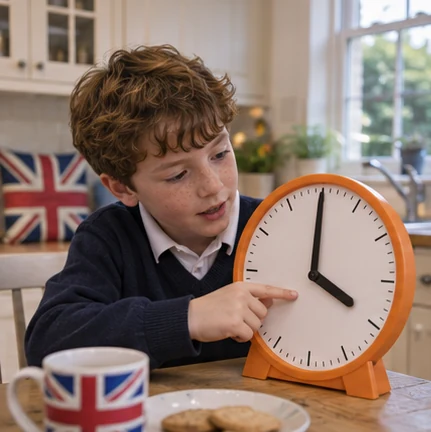
What does learning to tell the time look like?
Start with the hours. At 7 o’clock, the long minute hand points to 12 and the short hour hand points to 7. Move the hands to half past seven. The minute hand has travelled halfway round to 6, while the hour hand is halfway towards 8. A geared teaching clock can show the two moving together.
In England’s maths programme, Year 1 introduces hours and half hours. Year 2 includes quarter past, quarter to and five-minute intervals. Year 3 develops reading an analogue clock to the nearest minute. That progression describes teaching, so keep the classroom stage in mind before expecting a child to solve a new clock problem.
Pair clock reading with an event your child knows
Try a visual card for breakfast at 7:00. Draw the hands next to the digits and invite your child to tell you which is the minute hand. On another day, move breakfast on the practice clock to 7:30. Ask them to show you where the hour hand travelled. If the hands turn independently, help set the hour hand halfway between two numbers.
Later try counting around the clock in fives. Each move to the next number marks five minutes. At 7:45, the minute hand has reached 9 and the hour hand is on its way to 8. You can call it “seven forty-five” or “quarter to eight” and show that 15 minutes remain until eight. Keep the digital and analogue versions visible together.
Notice the step your child finds hard
Reading a time and finding how long a visit lasted require different reasoning. Put start and finish times beside a story, like a board game from 4:00 to 4:30. Ask how far the minute hand moved. Tell the teacher if your child regularly struggles to identify the hands, count by fives or understand time vocabulary. They can suggest a next step consistent with the class approach.
Frequently asked questions
Should a five-year-old read an analogue clock?
There is no universal deadline. Words such as before, after and tomorrow are useful early foundations.
Which hand should I teach first?
Find the shorter hour hand and longer minute hand together. Try one whole hour before adding half hours.
Why does the short hand sit between numbers?
It moves towards the next hour as minutes pass. At half past seven it is halfway from 7 to 8.
Is a digital clock enough for practice?
It can make the numbers familiar. Show both formats beside each other to practise how the hands represent the digits.
How can we practise without a worksheet?
Choose one routine that happens at a familiar time. Find its time on a real clock and set it on a model.
Sources
Türkçe · Deutsch · English · Français · 简体中文 · 日本語 · 한국어 · العربية
Bir yanıt yazın